Foundations - WEEK ONE - Day 1 – Lower Body Strength & Pulling / Posterior Chain
Rating 5.0
Functional, Gym, Abs & Core, All Levels, Mobility, Lower Body, Back, Strength, Arms
Start Smart. Build Your Base. Train With Purpose.
Functional Athlete Foundations is where purposeful training begins. Build strength, mobility, stability, and movement confidence through BUILD → CONTROL → INTEGRATE → RESTORE.
Over four weeks, you'll Learn It. Reinforce It. Challenge It. Own It.
Build the foundation for stronger, more capable movement, because every workout has a reason, and every movement has a purpose.

Rating 5.0
Functional, Gym, Abs & Core, All Levels, Mobility, Lower Body, Back, Strength, Arms
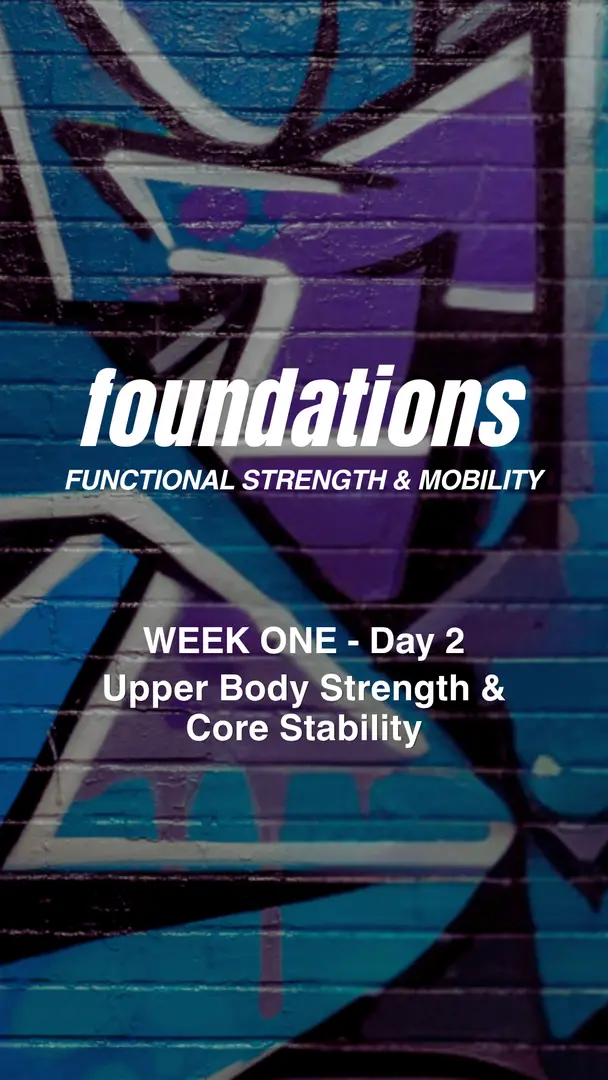
Rating 5.0
Gym, Strength, Mobility, Abs & Core, All Levels, Upper Body, Functional
Rating 5.0
Strength, Full Body, Functional, Gym, All Levels, Athletic Performance
Rating 5.0
Mindfulness, All Levels, Full Body, Mobility, Gym, Functional
Foundations is for anyone who wants to move better, become stronger, and build a more capable body. It’s ideal if you’re new to structured strength training, returning after time away, rebuilding your movement quality and confidence, or simply want to reinforce the fundamentals before moving into more advanced training. And if you already have training experience, don’t let the word Foundations fool you. Great athletes never outgrow great movement.
No. Foundations is specifically designed to meet you where you are. The movements begin with positions and variations that allow you to learn proper mechanics before progressing to greater resistance, range of motion, stability demands, integration, and eventually performance. If you’re already experienced, your challenge may be different. Instead of simply completing the exercises, focus on improving your control, execution, consistency, and movement awareness. Master the position first. Then earn the progression.
Foundations is a four-week program with four purposeful workouts each week. Every training week follows the DKF programming architecture: 1. BUILD: Develop strength and physical capacity. 2. CONTROL: Improve movement ownership, stability, and body control. 3. INTEGRATE: Connect strength, stability, mobility, and athletic movement. 4. RESTORE: Recover, reinforce movement quality, and prepare for what comes next. These aren't four separate types of fitness. They work together as part of one complete training system. BUILD → CONTROL → INTEGRATE → RESTORE
Foundations uses a deliberate learning process rather than simply giving you four weeks of different workouts. Week 1: LEARN IT Establish the positions and learn the movement. Week 2: REINFORCE IT Improve control, tempo, consistency, and movement ownership. Week 3: CHALLENGE IT Apply strength through appropriate resistance, integration, and greater movement demands. Week 4: OWN IT Perform with greater confidence, independence, and intent. Underneath that process is a simple progression: POSITION → CONTROL → STRENGTH → PERFORMANCE You won't see every exercise change every week, and that's intentional. Progress where progression serves a purpose.
Purposeful Training is the philosophy behind everything we do at Donny King Fitness. Every workout has a reason. Every movement has a purpose. We don't add exercises simply because they look difficult, create more fatigue, or happen to be popular. Every movement should contribute to the objective of the workout and your long-term development. Sometimes progression means more resistance. Other times it means better control, greater usable range of motion, improved stability, slower tempo, reduced assistance, better coordination, greater intent, or simply performing the same movement better than you did before. Different doesn't automatically mean better. Better is better.
Foundations is beginner-friendly, but it isn't only for beginners. Think of it as a foundation-building program. A newer athlete may use it to learn fundamental strength and movement patterns for the first time. Someone returning to training may use it to rebuild strength, movement quality, and confidence. An experienced athlete may use it to reinforce mechanics, address movement limitations, or reconnect with fundamental patterns before beginning a more demanding training phase. Fundamentals aren't something you graduate from and forget. They're what everything else is built upon.
No. But it also isn't designed to exhaust you just for the sake of making the workout feel hard. Week 1 may feel more instructional because you're learning positions, movements, and expectations. As the program progresses, resistance, control, range of motion, stability demands, integration, and movement intent can all increase. The goal isn't to make every week simply harder. The goal is to make you better. Train smarter, not harder. But don't confuse smarter training with easy training.
Choose a resistance that allows you to perform every repetition with good position and control while still feeling appropriately challenged. For most strength movements, you should generally finish with approximately 2–3 quality repetitions still available rather than taking every set to failure. Before increasing resistance, ask: - Can I establish the position? - Can I control the movement? - Can I maintain that control under resistance? - Can I repeat the same quality from the first repetition to the last? If the answer is yes, you may be ready for more. But remember: Progression doesn't always mean more weight. Control first. Then load.
Modify it. Exercises can be adjusted through resistance, range of motion, body position, assistance, tempo, incline, stance, or an appropriate substitution. Using an incline instead of the floor isn't failure. Using support during a single-leg movement isn't failure. Reducing the range of motion isn't failure. Those are coaching decisions. Never force a movement that causes pain simply because it appears in the program. The goal isn't to perform the most advanced variation. The goal is to perform the right variation well and progress when you've earned it.
Because recovery is part of the program. RESTORE is not an optional mobility day. These sessions use our restoration sequence: RESET → MOBILIZE → RECONNECT → RESTORE You'll work on mobility, movement quality, balance, stability, breathing, body awareness, and recovery without creating unnecessary additional fatigue. Restoration progresses too. Across the four weeks, you'll move from learning how to slow down, to connecting movements, exploring comfortable range, and eventually taking greater responsibility for your own recovery. The goal is simple: Leave the session moving better than when you started.
No. Foundations was designed around fundamental movement patterns and adaptable equipment. Depending on the workout and exercise variation, you may use dumbbells, kettlebells, resistance bands or cables, a bench or elevated surface, and, in a gym setting, a sled or similar resistance option. When a specific piece of equipment isn't available, focus on the purpose of the movement rather than trying to perfectly duplicate the exercise. The equipment is a tool. The training objective comes first.
Because repetition is how you learn. We intentionally maintain a familiar movement vocabulary throughout Foundations so you have enough time to actually improve the exercises instead of constantly learning new ones. Strength requires repetition. Skill requires repetition. Confidence requires repetition. The progression may come through resistance, tempo, range of motion, stability, reduced assistance, integration, intent, or simply better execution. We don't change things just to make them different. We change them when there's a reason.
Don't measure progress only by how much weight you add. You may notice that you: - Move through a greater comfortable range. - Need less assistance. - Control the weight more effectively. - Maintain better balance. - Perform the same movement with greater confidence. - Recognize and correct your own positioning. - Recover more effectively between workouts. - Or need fewer coaching cues to perform a movement correctly. That last one matters. One of our coaching principles at DKF is: COACH → TEACH → REINFORCE → STEP BACK As your understanding improves, you should become increasingly capable of recognizing quality movement for yourself. Reduced coaching is progression
First, recognize what you've accomplished. Over four weeks, you've built more than strength. You've developed movement awareness, stability, mobility, coordination, confidence, and a better understanding of how to train. From here, your next training path should reflect your goals. You may progress into any of our other DKF programs, or you may repeat Foundations when reinforcing your base is the smartest next step. There is no need to rush out of Foundations simply because you've reached the end of Week 4. The calendar doesn't earn the progression. You do.